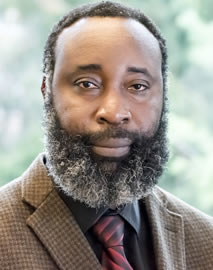
Adedoyin Teriba specializes in modern and contemporary architecture & urbanism — focusing particularly on such traditions in West Africa and its diasporas. Teriba’s teaching and scholarship investigate the ways in which folklore, orality, language, art, dance, and music are used as tools — historically and presently — to generate an architecture that creates a sense of place. Teriba is also interested in the ways that performance-based ways of creating architecture have been a staple of architectural design in parts of Africa and its diasporas for the last two hundred years or more.
At Dartmouth, Teriba teaches topics on modern and contemporary architecture that include the idea of architecture and urban spaces as mysterious entities; the intersection between architecture, place, and identity; the connection between industrial design and architecture; and courses on modern and contemporary architecture in various regions and nations in Africa.
Teriba’s current book project, Architecture’s Figures: Assimilation and Cultures in Colonial Nigeria, interrogates how African diasporic settlers in Southwest Nigeria and Nigerian locals used a motley of architectural forms (including neo-baroque) to create new figures of Yorùbá speech; novel ideas of immortality as well as impact regional masquerade designs and the directional flow of masquerade processions in urban Southwest Nigeria.

Titilola Marinho Anidugbe is a direct descendant of Jerônimo Joaquim Pereira Marinho, a returnee and patriarch of the Marinho family. With over 23 years of experience in IT Governance in various Blue-Chip Multinationals in Nigeria, Titilola has also attained many certifications in Project Management and CGIT. She is also the Managing Director of Marinho Agro allied Limited.

Professor Saheed Aderinto has published 8 books, 37 journal articles and book chapters, 40 encyclopedia articles, and 20 book reviews. He is the author of Animality and Colonial Subjecthood in Africa: The Human and Nonhuman Creatures of Nigeria (Ohio University Press/New African Histories Series, 2021); Guns and Society in Colonial Nigeria: Firearms, Culture, and Public Order (Indiana University Press, January 2018) and When Sex Threatened the State: Illicit Sexuality, Nationalism, and Politics in Colonial Nigeria, 1900-1958 (University of Illinois Press, 2015)–Winner of the 2016 Nigerian Studies Association’s Book Award Prize for the “most important scholarly book/work on Nigeria published in English language.”
His other books include, Children and Childhood in Colonial Nigerian Histories (Palgrave Macmillan, 2015,edited); African Kingdoms: An Encyclopedia of Empires and Civilizations (ABC-CLIO, 2017, edited); Nigeria, Nationalism, and Writing History (University of Rochester Press, 2010, co-authored) and The Third Wave of Historical Scholarship on Nigeria: Essays in Honor of Ayodeji Olukoju (Cambridge Scholars Publishing, 2012, co-edited). In addition, his works have appeared in leading Africanist and specialist journals including, the Canadian Journal of African Studies; Journal of Imperial and Commonwealth History; Journal of the History of Sexuality; Journal of Colonialism and Colonial History; History in Africa: A Journal of Method; Frontiers: A Journal of Women’s Studies; Africa: The Journal of the International African Institute; the Journal of Social History; and the Journal of the History of Childhood and Youth, among others. He is writing a book on the history of Fuji. Aderinto is the Founding President of the Lagos Studies Association.

Her multidisciplinary academic background includes a Bachelor’s degree in Social Communication (Journalism) from the Federal University of Bahia (UFBA), Brazil, alongside specialized training in African Diaspora and Identity from Boston University, Black Mobilization from UFBA, and Communication and Public Health through Johns Hopkins University and the Oswaldo Cruz Foundation (FIOCRUZ).
Ana has extensive experience in historical research, cultural preservation, archival work, and the documentation of Afro-descendant heritage. Since 1999, she has coordinated the Afro-descendant Families Memorial Project, dedicated to the protection, preservation, and dissemination of the material and intangible memories of Afro-descendant families. Her work also includes the organization of the ethnomusicologist Ralph Waddey’s collection and participation in international cultural exhibitions exploring Afro-Brazilian families and their transatlantic connections.
As an academic contributor, Ana has published chapters with internationally recognized publishers, including Palgrave Macmillan and Emerald Publishing. Her publications explore themes such as Afro-Brazilian women’s memories of displacement, racialization and social categorization, traditional Yoruba nobility in the African Diaspora, Black identity in the media, and the historical connections between Africans and Brazilians.
Her work bridges historical scholarship, family memory, cultural identity, and public engagement, contributing to a deeper understanding of the African Diaspora and the enduring connections between Africa and its global descendants. Through research, memorial initiatives, and cultural curation, Ana remains committed to preserving historical narratives, amplifying Afro-descendant experiences, and promoting awareness of African and Afro-Brazilian heritage.

Professor Ogunnaike teaches interdisciplinary courses on Africa and the African Diaspora that center around the important role religion plays in these communities. His research focusses mostly on Yoruba oriṣa worship in Nigeria, but also addresses Islam in Africa, Christianity in Africa, and diaspora religions—Brazilian Candomblé in particular.
Having studied Ifa divination with a high priest and diviner in Nigeria, he has a keen interest in indigenous African intellectual traditions and ways of knowing. His current book project, How Worship Becomes Religion, analyzes how the worship of traditional Yoruba deities originally differed greatly from Western notions of “religion” but eventually became the most widespread and celebrated indigenous African religion through contact with modernity and mission Christianity. He is also currently working on a children’s book of Yoruba mythology with his brothers Oludamini and Olumakinde and has been developing and curating an online library of Ifa orature.

Oluremi C. Onabanjo is a curator and scholar of photography and the arts of Africa based in New York City. The former Director of Exhibitions and Collections for The Walther Collection, she has organized exhibitions in Europe, North America, and Africa. In 2017 she co-curated Recent Histories: Contemporary African Photography, and edited its accompanying publication (Steidl), which was shortlisted for an ICP Infinity Award in Critical Writing and Research (2018). Onabanjo lectures internationally on photography and curatorial practice, and her writing has appeared in Aperture, The New Yorker, The Photobook Review, Tate Etc. and publications supported by The Museum of Modern Art, RISD Museum, and The Studio Museum in Harlem amongst others.
A 2020 Andy Warhol Foundation Arts Writers Grantee, Onabanjo is a PhD candidate in Art History at Columbia University. She holds an MSc in Visual, Material, and Museum Anthropology from Oxford University, and a BA in African Studies from Columbia University.
