
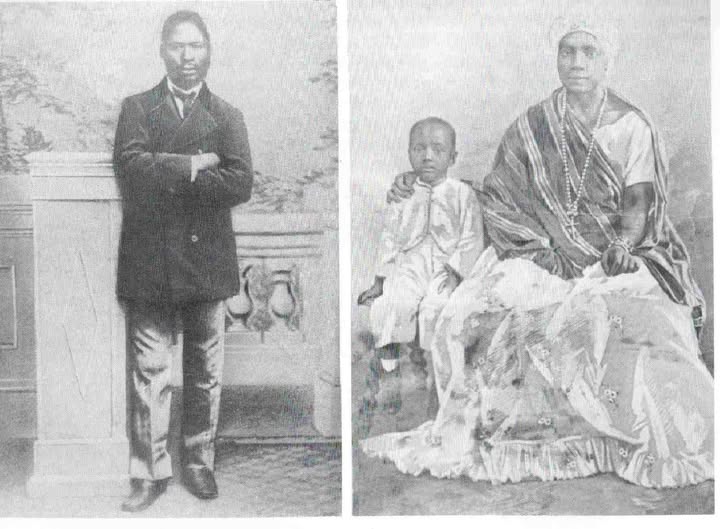
The Afro-Brazilian and Fante da Rocha family of Cape Coast trace their ancestry to this man on the left, João Esan da Rocha. On the far right, is Esan`s wife, Louisa Angelica Nogueira da Rocha with son, Cândido da Rocha (the man who will later become the first Nigerian millionaire). Circa 1870, Bahia in Brazil. (The photo is from Pierre Verger, Rocha-Thomas family collection).
The Afro-Brazilian da Rocha family of Nigeria and Ghana, especially the Da-Rocha Fante family of Cape Coast (of which the late national Chairman of the ruling New Patriotic Party, Bernardo João Da-Rocha aka B J da Rocha was one of its most well-known personality) trace their ancestry to João Esan da Rocha. B J da Rocha and his siblings had a Fante mother from Cape Coast who married Alexander Candido da Rocha. Alexander was the first born child and the only son of Cândido da Rocha, the first Nigerian millionaire who owned racehorses and luxurious carriages. Cândido`s father was Esan da Rocha.
Esan da Rocha, was a Nigerian Yoruba from the sub-Yoruba ethnic group Ilesa. In 1840, he was captured and sold into slavery in Brazil at the tender age of 10, but he worked successfully to buy his manumission {freedom) in 1871 at the age of 30. Whilst in Brazil, Esan married Angelica Josephina da Rocha. The couple gave birth to their son, Candido da Rocha while still in Brazil.
After gaining his freedom, Esan alongside other freed slaves were able to trace their roots back to the Yoruba ethnic group in Nigeria, where they were known as Aguda and in Ghana as Tabons (Tabom). Back in Nigeria, Esan Da Rocha was one of the returnees that approached the then Queen Victoria’s representative in Lagos to request a place for their resettlement in Lagos and they were apportioned the areas between the Central Bank of Nigeria on Broad Street up to Kam Salem, at Obalende. The Water House (Casa de agua) was built by Esan Da Rocha on the land apportioned to him. He was given two portions of land because he came back with his wife of Nigerian origin and four children so he also got a portion of land on Tinubu Street. While building his own house, Esan built it as a replica of the house he lived in Brazil. His houses are the famous Water House at Kakawa Street and the other one is on 4, Tinubu Street both on Lagos Island. Esan died at the age of 88 and was buried at Ikoyi Cemetery.
Candido da Rocha stepped into his father’s business empire, which he later expanded and consolidated into a multi-million pound financial empire, straddling agriculture, hotel, trading, real estate, banking and financial investment.